
🛠️🎹 Professional Piano Repairs & Renovations in Abergavenny, Monmouthshire & South Wales
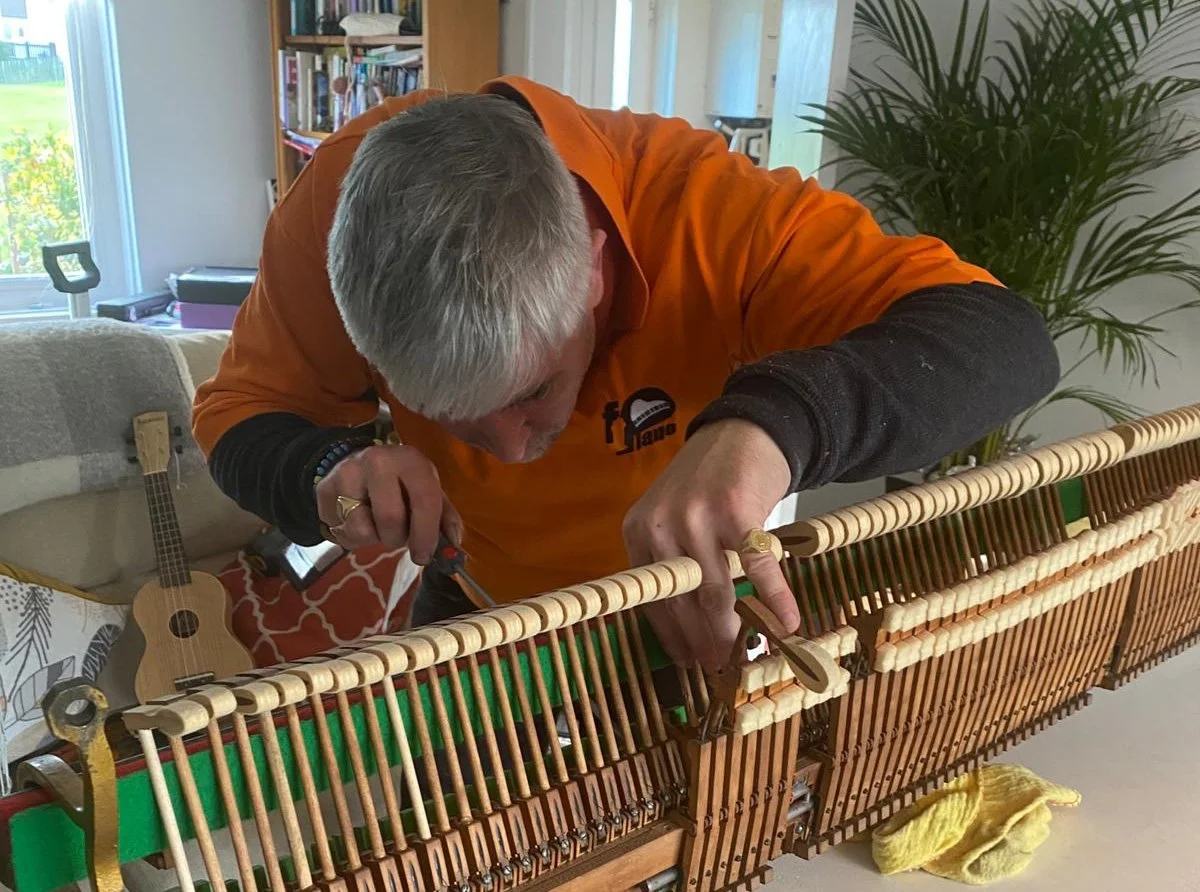
When your piano develops mechanical issues or no longer plays as smoothly as it should, professional repair and renovation can bring it back to life. I provide expert piano repairs and renovations in Abergavenny, Monmouthshire, and across South Wales, restoring everything from sticky keys and pedal problems to worn actions and castor replacement. I also supply and fit safety castors. Whether your piano needs a simple repair, detailed regulation, or a full refurbishment, I offer careful, skilled workmanship to help your instrument perform at its best.

Repairs and renovation
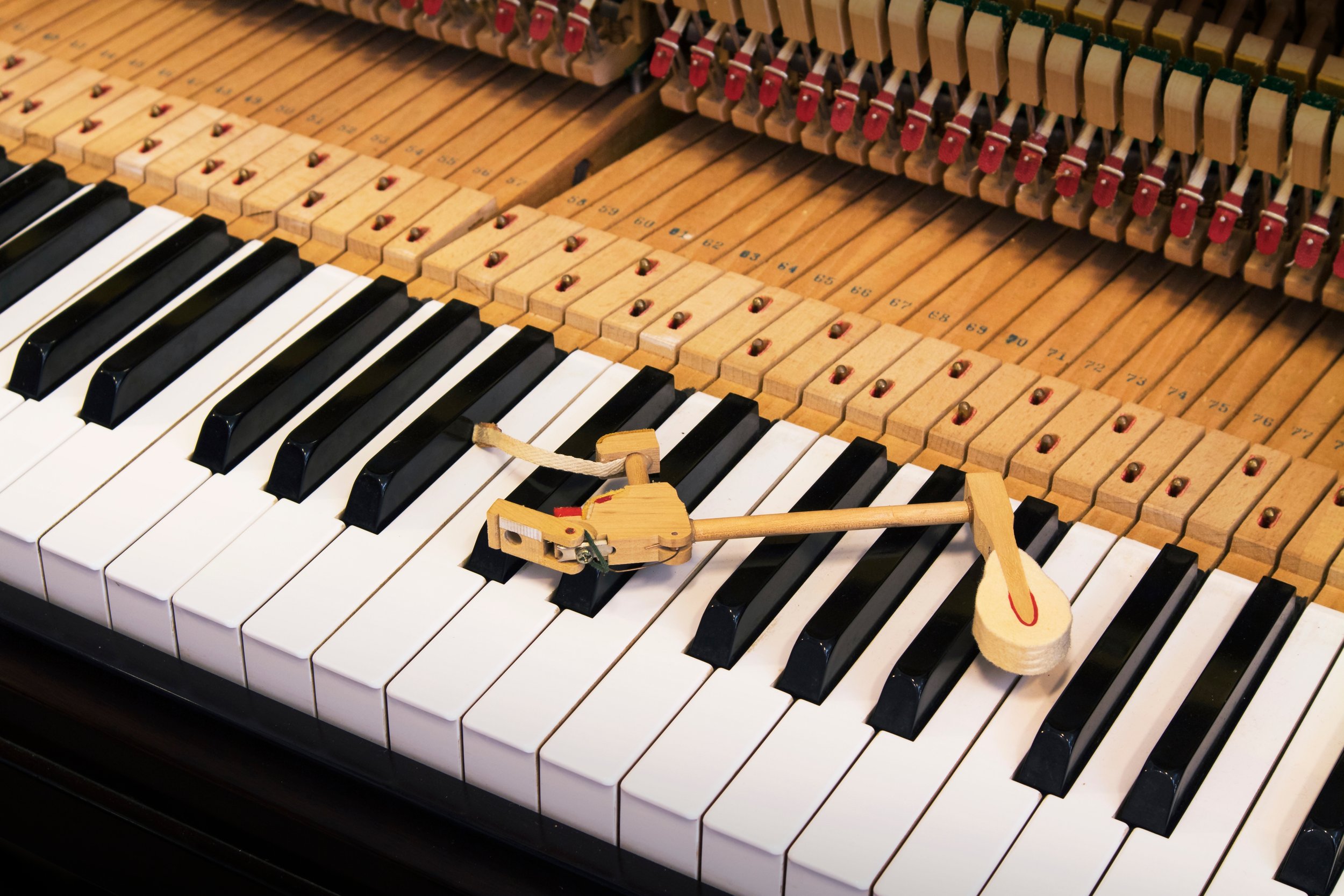
We repair the majority of ailments that pianos suffer from as Father Time plods on, anywhere in the South Wales area. Minor repairs include niggles such as renewing tie tapes that have disintegrated over time or servicing the pedal mechanisms to eradicate creaks and squeaks. More significant fixes such as broken hammer shanks or the replacement of cushions, felts or leathers are also well within our remit. Indeed we recondition complete actions on request. Get in touch and we can discuss your requirements.

Same day renovation
A same-day renovation is for those with a piano that requires more significant repair in Abergavenny, Monmouth or South Wales.
This service includes:
Extended 7-hour Appointment
Repairs
Keyboard service, regulation and lubrication
Action service regulation (reset the geometry of the action)
Case detailing (where possible)
Pitch correction tuning
Pure twelfths fine tuning
A combination of piano repairs, piano tuning, pitch correction (if possible), action regulation, keyboard servicing and case detailing can literally transform a well-loved piano and bring it back to the best it can be. Anything and everything will be done to improve the instrument in a day. All miscellaneous materials, polishes and lubricants are included. See below for details on these restorative services.
£POA
Piano Voicing
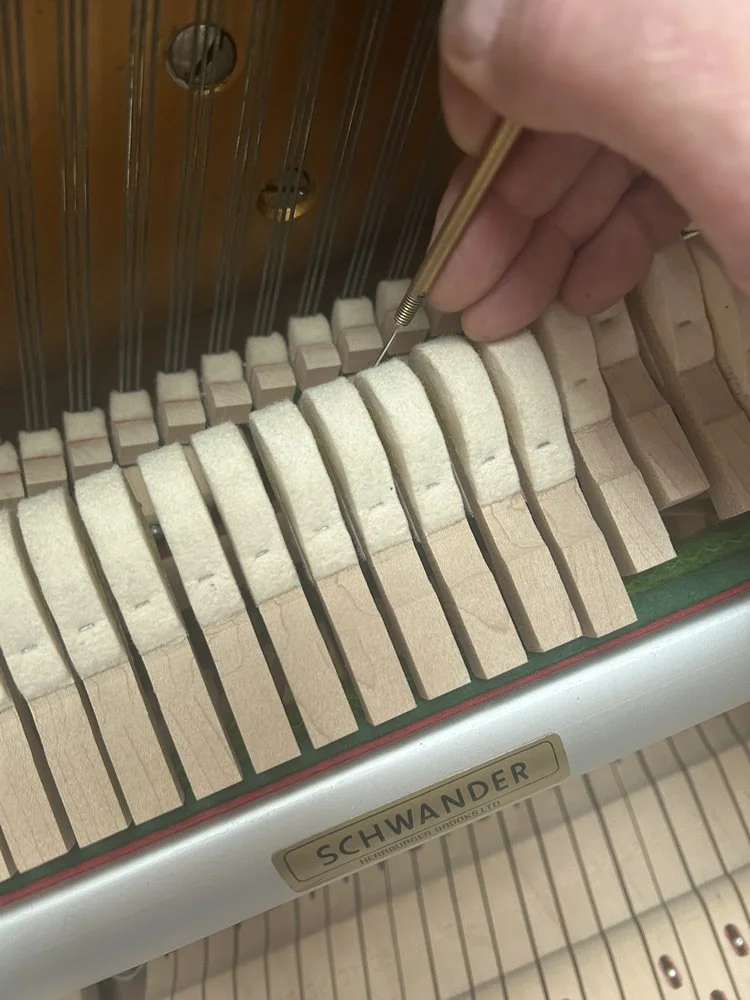
Piano voicing is the process of adjusting the hardness, shape, and condition of the hammers so the piano produces a balanced, pleasing, and expressive tone. Over time, hammer felts become compacted, grooved, or uneven, which can make a piano sound:
Too bright or harsh
Too dull or lifeless
Uneven from note to note
Lacking warmth, clarity, or power
Voicing restores the piano’s tonal character and ensures the instrument sounds its best across the entire keyboard.
Voicing is a skilled, detailed process that may include:
Needling the hammer felt to soften overly bright or harsh tone
Hardening the felt (with specialist solutions) to add clarity or projection
Shaping and filing the hammers to restore their correct profile
Aligning hammers to the strings for clean, even tone
Correcting hammer travel to ensure consistent strike
Balancing tone across registers so the piano sounds even from bass to treble
Each adjustment affects how the piano speaks, blends, and responds to the player. The aim is to improve:
Warmth and richness
Clarity and definition
Dynamic range
Evenness across the keyboard
Overall musical expression
For many pianos — especially older uprights and grands — voicing is one of the most effective ways to restore beauty and character to the tone.
Action Regulation & Optimisation
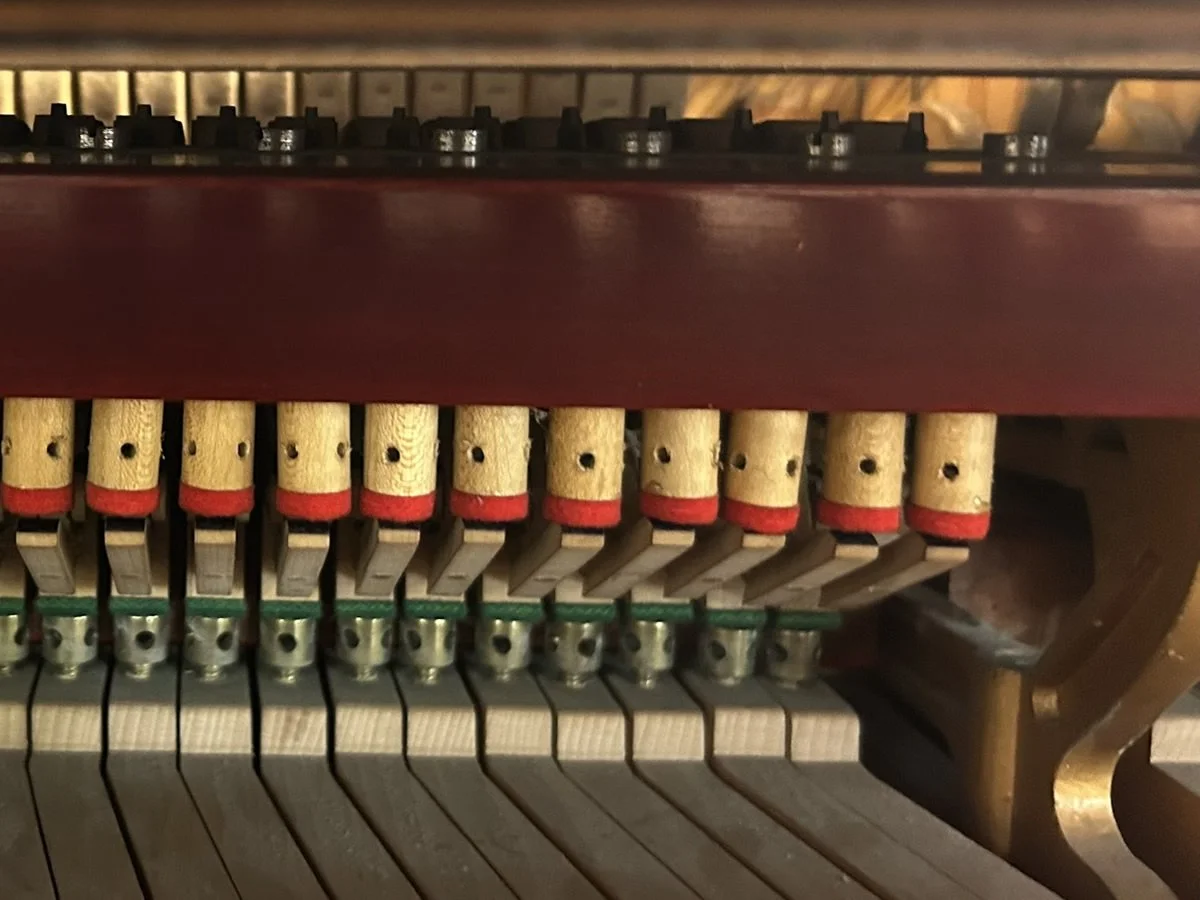
Action regulation and optimisation is the process of adjusting, refining, and balancing all the moving parts inside a piano’s action so the instrument plays smoothly, evenly, and responsively across the entire keyboard. Over time, felt compresses, wood settles, and components drift out of alignment, causing uneven touch, sluggish notes, and reduced control. Regulation restores the action to its correct geometry and performance.
Regulation is a detailed, step‑by‑step process that ensures:
Every note plays with the same depth and resistance
The hammer strikes the string at the correct point and speed
Repetition is fast, reliable, and responsive
The touch feels even and predictable
The pianist has full control from ppp to fff
To achieve this, a technician adjusts key and action components such as:
Key height and key dip
Hammer blow distance
Let‑off (where the jack releases the hammer)
Drop
Backcheck distance
Repetition spring tension (grand pianos)
Hammer alignment and travel
Damper timing and lift
Each of these adjustments directly affects how the piano feels, responds, and produces tone.
If your piano feels heavy, uneven, slow, or unpredictable, it’s often due to the action being out of regulation. A full regulation restores:
Smooth, even touch
Better control and expression
Faster repetition
Improved tone and power
A more enjoyable playing experience
For many instruments, action regulation is one of the most effective and transformative repairs you can invest in.

Keyboard servicing
Are your piano keys sticking or slowing you down? It’s one of the most common and frustrating problems pianists experience — and fortunately, it’s also one of the easiest to fix professionally.
The main culprit is humidity. Moisture causes:
Felt bushings inside the keys to swell
Guide pins to corrode or become rough
Increased friction between the key and the pin
When the felt swells and the pins aren’t perfectly smooth, the keys begin to grip instead of gliding — which results in sticking, sluggish, or uneven movement.
A full keyboard service removes the cause of sticking keys and restores smooth, responsive touch.
1. Easing swollen key felts
Any keys that are particularly tight are eased by carefully reducing the thickness of the swollen felt — restoring the correct clearance around the guide pins.
2. Removing and cleaning the entire keyboard
All keys are removed from the piano, and the key bed is vacuumed to clear out years of dust, debris, and the occasional surprise object that finds its way inside.
3. Cleaning and polishing the guide pins
The guide pins are burnished and polished until perfectly smooth, removing corrosion and friction.
4. Lubricating for long‑term smoothness
Guide pins are treated with dry Teflon
Key bushings are lubricated with powdered Teflon
This creates a low‑friction, long‑lasting glide that makes the piano noticeably nicer to play.
A keyboard service for grand pianos is more involved due to the design of the action and key frame. The goal is the same — smooth, even, reliable key movement — but the process takes longer and the price depends on the individual instrument. This can be discussed during your tuning appointment.
Keyboard servicing
Eradicate sticking keys and make your instrument play so much better.
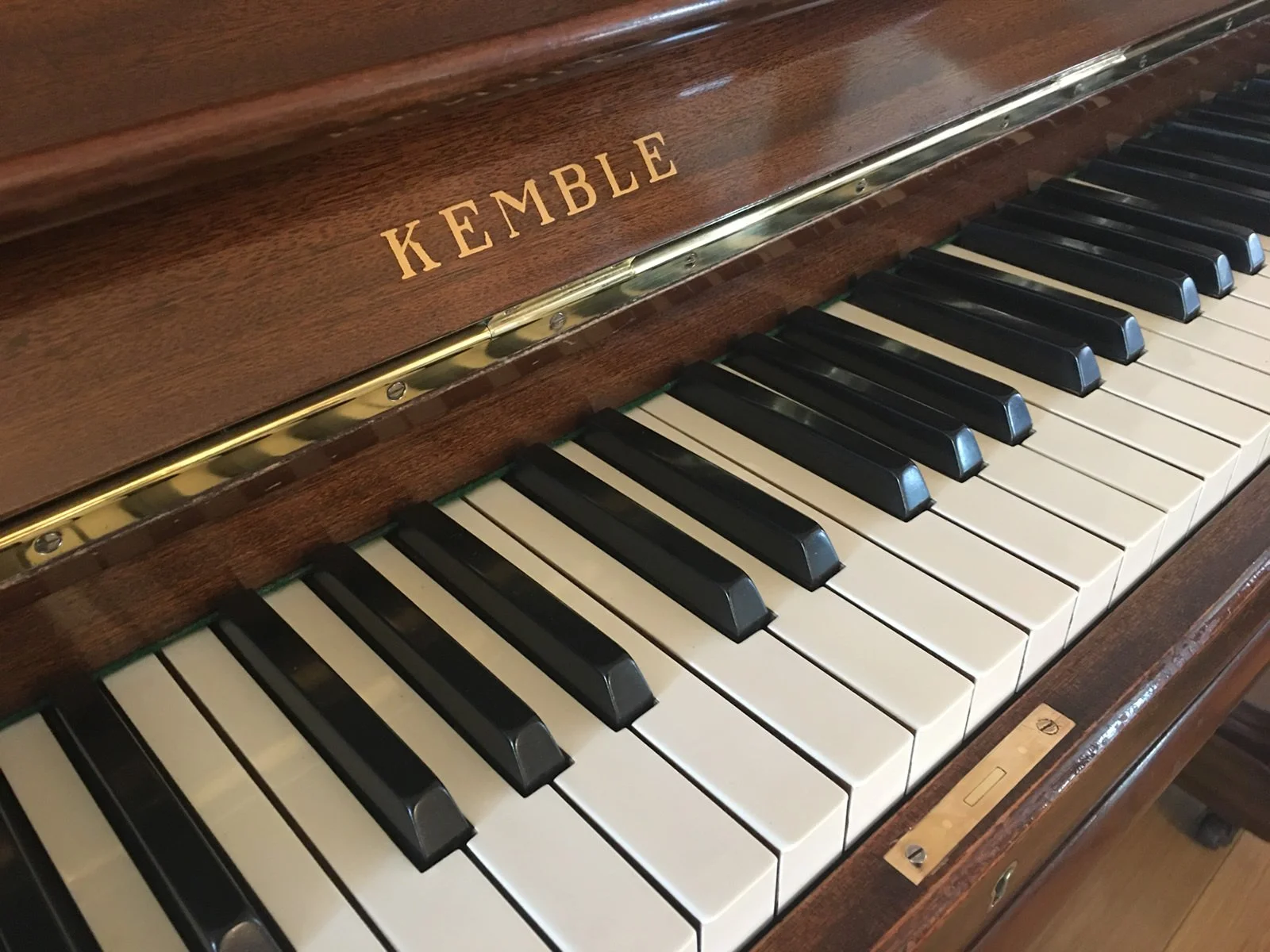
Case detailing
Case detailing is a fantastic way to transform the appearance of your piano and bring back its original charm. A well‑detailed case doesn’t just look cleaner — it can make your piano look like a completely different instrument.
1. Deep cleaning of the keys
The keys are thoroughly cleaned using specialist, ivory‑safe polish to remove dirt, oils, and years of build‑up.
2. New nameboard felt
We replace the nameboard felt (the strip where the back of the keys meet the case) with a fresh, high‑quality felt in your choice of colour. Traditional options include red, green, or blue, but we also offer modern colours and even two‑tone combinations for a personalised touch.
3. Scratch and blemish improvement
Light scratches and marks on the case are treated with carefully matched French polish, helping the finish look smoother and more uniform.
4. Polishing the brasswork
Hinges, pedals, and other brass fittings are mirror‑polished to restore their shine and remove tarnish.
5. Fallboard and name detailing
The fallboard (keyboard cover) is polished, and where possible, the manufacturer’s name is cleaned and detailed to stand out clearly again.
6. Final case polish
The entire piano case is polished with a non‑silicone wax, giving it a clean, rich, professional finish without damaging the wood.
This service can dramatically improve the appearance of your piano, making it look cleaner, brighter, and far more presentable in your home.
Case detailing for grand pianos is more intricate due to the larger surface area and more complex casework. Pricing can be discussed during your tuning appointment, as it depends on the individual instrument.
Case detailing
Transform the way your instrument looks. Its not just about the way it sounds.
🛞 Castor Replacement
Over time, piano castors can seize, flatten, or fail under load, placing unnecessary stress on the legs and compromising the instrument’s structural stability. I provide a specialist piano castor replacement service, and cover Abergavenny, Monmouthshire and the wider South Wales area, fitting high‑quality units engineered to support the full static and dynamic weight of upright and grand pianos. All replacements are fitted with precision to maintain the piano’s balance, height, and overall mechanical integrity.
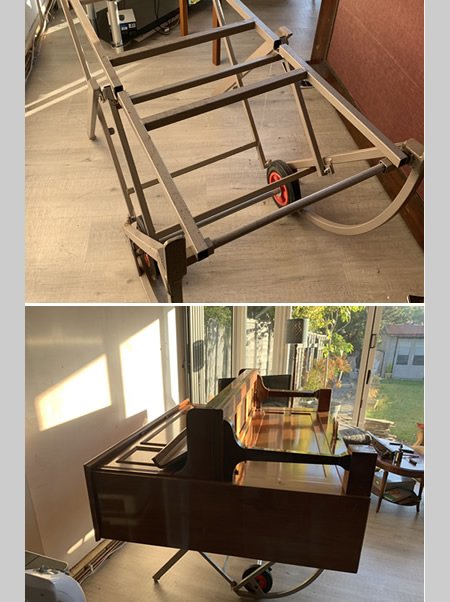
Fitting
Properly installed castors improve stability, protect the legs from stress, and allow the piano to move smoothly without damaging your floors. The piano must be lifted using proper lifting equipment. We use a bench truck for this purpose which allows the piano to be turned on its back to gain access to the under belly. For uprights, the weight is unevenly distributed, so the lift must be done carefully to avoid:
leg fractures
twisting the frame
damaging the keybed or back posts
For grands, the leg being worked on is supported individually.
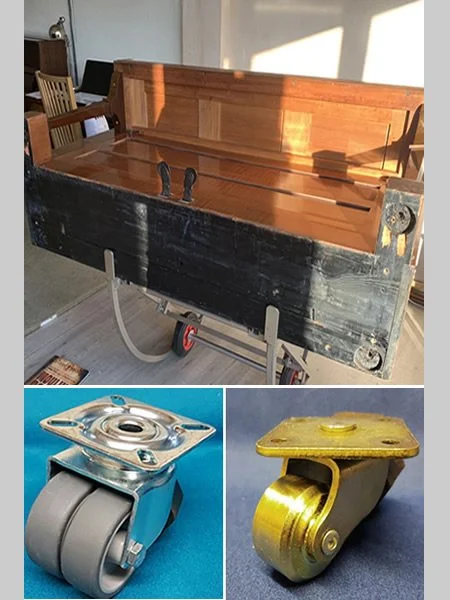
Castor Types
Depending on the instrument and flooring type, I can install solid‑brass castors, heavy‑duty double‑wheel assemblies, various safety castors to suit all piano styles or rubber‑tyred castors designed to reduce vibration transfer and protect delicate surfaces. Correctly specified castors ensure smoother movement, improved load distribution, and reduced risk of leg fractures — particularly on older pianos where timber joints may already be weakened.
The new castors are installed using:
correct‑size screws or bolts
proper alignment to maintain piano height and balance
torque that won’t split the wood
Rubber‑tyred castors are aligned to reduce vibration transfer and protect floors.
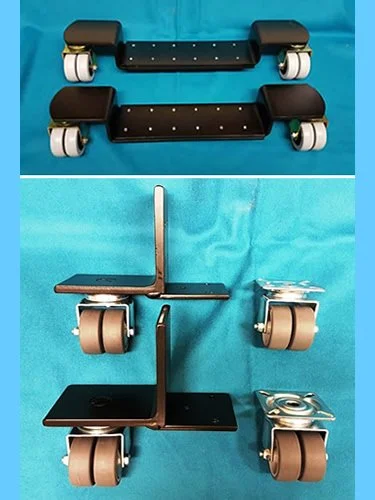
Safety Castors
Upright pianos are inherently unstable instruments. Much of their considerable weight sits high up and towards the back, creating a natural imbalance that can make them hazardous if moved or knocked without proper precautions. To significantly reduce the risk of tipping, I supply and fit professional safety brackets and rear toe‑kits designed specifically for upright pianos. These proven systems have been used for many years and are essential for ensuring stability in schools, public buildings, community spaces, and any environment where safety is a priority.

🚗 Call out charge
You may have a piano that has been in the family for many years but Father Time has not been kind and you want to know if it’s possible to restore it. We are more than happy to come and have a look and give you a condition report. There is a call out charge incurred to cover the time and fuel involved but it is credited if you decide to have any work done.
£150
🎹🛠📋 Assessments
If you need a written insurance valuation we can help. Fire damage, water damage or accidents can be assessed for the purposes of making a claim.
£150
If you are considering buying a piano and you need a wingman to give you a condition report, we can help with that too.
